If you’re leading a transformation right now, chances are you’re working hard.
The roadmap is built. The workstreams are running. People are showing up.
And yet, somewhere underneath all of that activity, there’s a quiet sense that something isn’t quite working.
The energy is lower than you expected. The results are slower than you hoped. And the world around you keeps moving, whether your plan is ready for it or not.
So let me ask you something:
When was the last time you paused to ask whether the way you’re transforming still fits the reality you’re operating in?
Not to revisit the strategy deck. Not to update the KPIs. But to really ask: are we doing this in a way that can actually keep up?
The Problem With the Three-Year Roadmap
Let’s be honest.
The dominant model for transformation is still a heavy, upfront plan. A detailed roadmap. A fixed destination. A launch moment followed by years of execution.
And it made sense. Once.
But here’s what I’ve seen, in organisations of all sizes, across industries:
The plan gets built in a world that no longer exists by the time execution begins.
Customer expectations shift. Technology moves. New leaders arrive with new priorities. And the people who were meant to carry the transformation? They disengage, because nobody asked them how it felt to live inside the plan.
Leading transformation based on a fixed roadmap is like navigating a moving city with a map that was drawn three years ago.
At some point, it becomes worth asking: Do I want to lead change based on a plan, or based on what’s actually happening?
Adaptive Transformation Is Not a Trend
Adaptive transformation is not a new methodology.
It’s not a framework you bolt on.
It’s a fundamentally different way of thinking about change. One that accepts, from the very beginning, that the path will evolve. That what works today may not work tomorrow. That the organisation itself needs to be as flexible as the environment it’s operating in.
The organisations that are genuinely succeeding at transformation have understood something important:
There is no cookie-cutter model.
What they have instead is a stable core — a clear purpose, a brand promise, a shared sense of why they exist — and around that, everything else is built to flex.
Structure. Teams. Ways of working.
All of it designed to adapt as the organisation learns.
Sensing: The Skill Most Organisations Haven’t Built
One of the most important capabilities in adaptive transformation is also one of the least developed.
Sensing.
Not just collecting data. Not just running quarterly reviews. But building a genuine, organisation-wide ability to notice what’s changing — and do something about it before it becomes a crisis.
The best adaptive organisations don’t wait to be told something has shifted. They’ve built systems to feel it.
This is where AI is opening up a completely new world of possibilities. The ability to take quantitative data, qualitative data, signals from across the organisation and across the customer journey — and extract intelligence from all of it, in real time, is something that simply wasn’t available before.
But sensing isn’t only about data.
It’s also about human signals.
There’s a brilliant example from the restaurant world — a simple gesture introduced by a team to signal when someone needed help. Touch the lapel. That’s it. One small signal that told everyone: I need support right now.
In a busy organisation, those signals exist everywhere.
The question is whether you’ve designed a way to hear them.
And whether the people closest to the work feel safe enough to send them.
Responding Well Means Designing for It
Sensing is only useful if it leads somewhere.
This is where many organisations get stuck. They have the data. They have the insights. But by the time those insights reach the people who can act on them, the moment has passed.
The rhythm is wrong.
I see this constantly: an agile team working in two-week sprints, receiving insights on a monthly or quarterly cycle. That’s completely out of sync. The team is moving at one speed. The intelligence is arriving at another.
Adaptive organisations design their operating rhythm deliberately. They ask: at what frequency do we need to check in, decide, and adjust?
This also means assembling the right people around the right problem — and being willing to change who’s at the table as the problem evolves.
Cross-functional teams. Different perspectives. The courage to bring in someone new when the situation demands it.
Not the same composition every time. Not the same meeting every quarter. But a genuine, responsive rhythm built around what’s actually happening.
The Yin and Yang of Problem Solving
Here’s something I keep coming back to.
Every organisation has a default way of thinking. Either it skews divergent — lots of exploration, lots of ideas, but never quite landing on action. Or it skews convergent — fast decisions, clear execution, but missing the richness that comes from going wider first.
Both modes matter. The question is when to use each one.
Divergent thinking opens up possibilities. Convergent thinking turns them into action. Adaptive transformation requires both — in the right sequence.
This isn’t abstract. It’s practical.
Something as simple as starting a meeting with: “The first twenty minutes are for divergent thinking. Then we converge.” That one decision changes the quality of everything that follows.
USAA — the US insurance company serving military families — built this into their organisation in a beautifully simple way. They identified five human-centred questions. Things like: Have we talked to actual people about what we’re building? What’s the riskiest assumption we’re making? Have we pivoted based on feedback?
They printed those questions on cards small enough to fit in a badge holder. And gave them to everyone.
Not just the strategy team. Not just the leaders. Everyone.
Because the ability to think adaptively isn’t a senior leadership skill. It’s an organisational one.
Traveling Purposefully Toward a Vague Destination
There’s a word I came across recently that I haven’t been able to stop thinking about.
Codiwomp.
It means to travel purposefully toward a slightly vague or unknown destination.
That’s transformation. That’s exactly what we’re all doing, whether we admit it or not.
And the sooner leaders stop pretending they have all the answers — the sooner they make room for real learning, real collaboration, real adaptation — the more credible they become.
Not weaker. More credible.
I think about this as concentric circles. You don’t arrive at transformation. You move through it in waves. First some education, some shared language, some alignment. Then you apply that to real problems. Then you go deeper. Then wider. Each circle building on the last.
The destination isn’t fixed. But the direction is clear. And that’s enough.
I know that’s uncomfortable for some leaders. Especially those who built their authority on having the answers.
But the organisations I’ve seen truly transform? They have leaders who are honest about the uncertainty. Who say: we’re learning as we go. Who create space for others to do the same.
The Real Challenges Nobody Talks About Honestly
Let’s not pretend this is easy.
Because it isn’t. And if someone is selling you an adaptive transformation model with no mention of the hard parts, I’d be sceptical.
The mindset shift is real. And it’s hard.
Most organisations are running on a quarterly results cycle. Metrics. KPIs. Delivery commitments. And adaptive transformation asks you to invest in longer-term thinking at the same time. That tension doesn’t go away. You have to hold both.
Leadership changes are a huge risk. A new leader arrives with a new plan, a new energy, a command-and-control reset — and years of organic adaptive progress can unravel in months. This is why culture, not just strategy, has to be the foundation.
And then there’s the relationship with failure.
Most organisations say they embrace it. But then they build metrics that punish it and cultures that shame it. Reflection gets skipped. Experiments get buried. And the learning that could have made the next step better disappears.
I came across one organisation that actually measured their rate of failure as a positive indicator. Not to crack down on it — but to make sure it was high enough. To confirm the organisation was genuinely experimenting.
That’s the shift.
Not failure for its own sake. But learning as the goal. And failure as a sign you’re actually trying.
Three Places to Start Tomorrow
If you’re a leader reading this and thinking: I want more of this, but where do I actually begin?
Start here.
Reflect on your thinking mode. Individually, and as a leadership team: are you exploring enough before you converge? Or are you deciding too quickly without enough richness? Even naming that imbalance starts to shift it.
Start with your customers’ top three goals. Not your business goals. Your customers’. What are the most important things they’re trying to do when they interact with you? And how are you tracking whether that’s changing? If you don’t have a good answer to the second question, that’s your starting point.
Pick one painful journey and treat it as your adaptive test case. Where are customers struggling most? Start there. Ask honestly: how good are we at sensing and responding here? Who needs to be involved? What would a small experiment look like instead of a full programme? Build the muscle. Then expand.
Don’t try to make the whole organisation adaptive overnight. Pick one thing. Learn. Move.
What Adaptive Transformation Actually Feels Like
Here’s what I keep coming back to, after 25 years of working on transformation.
The organisations that embrace this way of working don’t just get better results.
They get more energy.
Teams feel invested because they’re learning, not just executing. Leaders feel more honest because they’ve stopped pretending. And customers feel the difference, because they’re interacting with an organisation that’s genuinely listening.
That energy is real. I’ve felt it in the conversations. I’ve seen it in the teams that make this shift.
It doesn’t come with a neat three-year plan.
But it comes with something better.
The ability to move with the world instead of against it.
And that, ultimately, is what transformation is supposed to do.
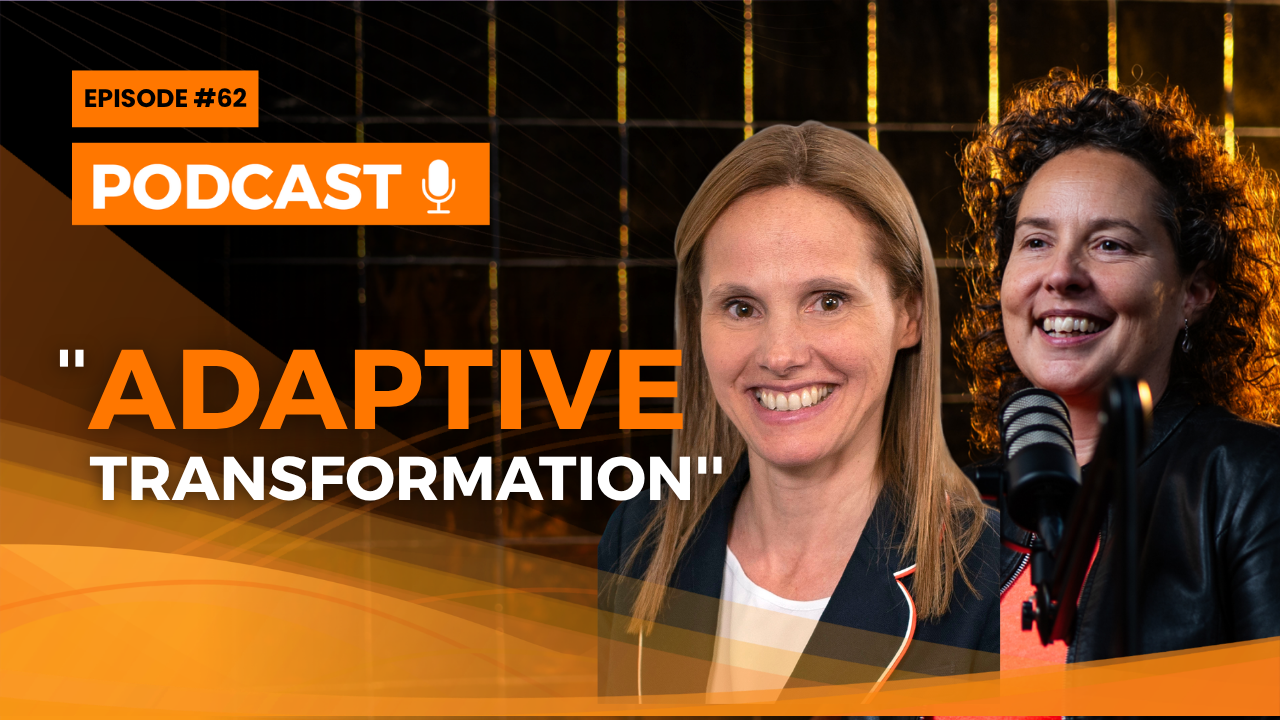
This is based on a conversation with Joanna, a fellow transformation thinker and expert on adaptive strategies. Check out the full podcast episode.
This topic connects to Layer 3 of Zanna’s new book: Once You See It — on behaviors for human-centric transformation. You can order the book here.