If you’re reading this, chances are you’re leading something that matters.
A team. A transformation. An organisation. Maybe all three at once.
And I want to ask you something simple:
When was the last time you chose the right path over the easy one?
Not the path that managed the most friction.
Not the path that kept everyone comfortable.
But the one you actually believed in.
Why Courage Sits Underneath Everything
We talk a lot about strategy in leadership. About vision. About transformation.
And those things matter.
But here’s what I’ve come to believe after years of working with leaders navigating real change:
All of it rests on courage.
Without it, the strategy is just a document. The vision is just a slide. The transformation is just a project with a name.
Courage is the thing underneath everything else.
And yet, it’s the behaviour we invest in the least.
We build frameworks. We run programmes. We send people on courses.
But asking yourself honestly — am I actually being courageous, or am I performing courage? — that’s rare.
And it might be the most powerful question you ever sit with.
Two Directions. Both Hard.
I think about courage as having two very distinct dimensions.
The first is the courage to stand for something bigger than yourself.
To hold the direction when the pressure mounts. To stay committed to human-centric leadership when the short-term, financially driven world is pulling you somewhere else. To say: I believe this is right, even when it’s inconvenient.
That sounds straightforward until you’re in a difficult quarter.
Until the board wants results now.
Until every signal in your environment is pointing toward safe, familiar, and fast.
That’s when conviction stops being inspirational and starts being genuinely hard.
The second dimension is quieter. And in some ways more confronting.
It’s the courage of not having all the answers.
We live in a world that is more uncertain, more complex, and more unpredictable than anything most of us were trained for. The link between past experience and future success? It’s broken.
And yet, so many leaders still feel the pressure to project certainty.
To perform confidence they don’t feel.
To pretend the map is clear when they’re navigating in the dark.
Here’s the truth:
In a world this uncertain, vulnerability is not weakness.
It’s one of the bravest things you can do.
The Inward Journey: The Biggest Assignment of All
If courage is about standing for what you believe in and leading through genuine vulnerability, both of those things require something no framework can give you.
They require you to know yourself.
Not the professional version of yourself. Not the leader-brand you’ve carefully constructed.
The actual you.
The one who carries the patterns. The fears. The old stories — from early career, from childhood, from every time you were told to toughen up, fit in, or not take up too much space.
I believe the inward journey is the biggest leadership assignment of all.
Because here’s what happens when we skip it:
We project.
We project our fears onto our organisations. Our unresolved patterns onto our teams. We see threat where there is curiosity. We hear criticism where there is care.
And then we wonder why our leadership isn’t landing.
You cannot lead others somewhere you haven’t been willing to go yourself.
Once You See It
One of the most powerful things about doing inner work is what happens to your awareness over time.
At first, you notice a pattern days after it showed up.
Then hours.
Then moments.
And eventually — before you act.
That’s the moment you regain choice.
That’s the moment real change starts.
This is why I called my book Once You See It.
Because once you truly see through a pattern, you cannot unsee it.
And that’s exactly where growth begins.
From Human Doings Back to Human Beings
Somewhere along the way, we stopped being human beings and became human doings.
Look around any senior leadership team. Full calendars. Back-to-back meetings. Constant connectivity. Relentless urgency.
Everyone running faster.
And yet, often, the more we do — the more disconnected we become.
From our teams. From our purpose. From ourselves.
The paradox is real:
In a world that demands we move faster, the answer is often to slow down.
Stand still. Reflect.
That’s the missing ingredient.
I know how that sounds. I know the voice that says: my stakeholders won’t wait, the numbers don’t care about my reflection practice.
But the leaders who are most effective in complexity are almost always the ones who have made peace with stillness. Who have built, even in the chaos, pockets of genuine presence.
It’s not indulgent.
It’s essential.
Doing It vs. Living It
Many leaders have been on all the courses. They can talk about psychological safety, growth mindset, servant leadership.
And then they go back to the office.
And nothing changes.
There’s a name for this: absent seeing. Learning that stays entirely cognitive. You understand the concept, you can explain it — but you’re not living inside it.
You’re doing it. But you’re not being it.
I see this with courage all the time.
A leader who says they want their team to experiment more, to fail fast, to take risks.
And when you ask them — when did you last share a moment you failed? When were you visibly vulnerable? — the answer is silence.
That gap between knowing and living is not a failure.
It’s information.
And the path from one to the other runs straight through the inner work.
The Noble Warrior
So how do you become more courageous — not just aspire to be?
One concept I love and use a lot in my work is the idea of the noble warrior.
We all have warrior energy. The part that drives, that sets direction, that doesn’t back down.
Many of us have been told, explicitly or not, that this part is dangerous. That pushing hard makes you unsafe. That strong conviction is the same as being closed.
So some of us suppress it.
We manage instead of lead.
But the world right now needs warrior energy.
The question is not whether to activate it.
The question is what kind of warrior you’re going to be.
The noble warrior fights the good fight for a cause that is bigger than themselves.
Not ego-driven. Not for personal gain.
But for the organisation. For the people. For something real.
When people sense that — and they do sense it — everything changes.
They stop resisting and start following.
Not because you told them to.
Because they can feel the difference between someone advancing their agenda and someone fighting a just cause.
Ask yourself honestly:
Am I part of a goal that is larger than me?
If you can feel it, not just state it, the warrior energy flows more freely.
When You Meet Resistance
Let me be honest about something.
Courage in leadership doesn’t mean smooth sailing.
Often, the more you stand for something, the more resistance you’ll meet.
And here’s something worth holding:
Most resistance is not really about the change. It’s about loss.
When we roll out transformation, we sell the future. The opportunity. The new world. We focus entirely on what’s being gained.
But the people in front of us are often not in the future yet.
They’re grieving.
Grieving the familiar processes. The relationships. The sense of competence they had in the old way of doing things.
That grief is real.
And it deserves to be acknowledged.
So yes — hold the direction. Activate the noble warrior.
But slow down enough to hear what the resistance is actually telling you.
Because sometimes it contains something important.
And sometimes it just needs to be witnessed before it can move.
The Authenticity Trap
There’s something else that blocks leaders from growing — and it’s surprisingly common.
It sounds like this:
“This doesn’t feel like me.”
If I try to change, to behave differently than I do today — isn’t that fake? Isn’t that inauthentic?
And so people get stuck.
Expressing themselves authentically as they are today. Unable to move.
Here’s a reframe that I’ve found genuinely helpful:
Think about trying on new clothes. The first time you wear something unfamiliar, it might not feel quite like you. But you’re not committing to it. You’re just trying it on for size.
Maybe it’s right. Maybe it’s not.
But it’s not fake.
It’s you — experimenting.
Shifting from “this is fake” to “I’m trying this on for size” can unlock everything.
Because growth doesn’t always feel like yourself at first.
That’s kind of the point.
Feel the Fear. Go Anyway.
I want to say something that sounds simple but needs to be said clearly.
Courage doesn’t mean the absence of fear.
It means not letting fear make your decisions for you.
Many leaders are waiting to feel ready. Waiting for the uncertainty to resolve before they act. Waiting for the moment it stops feeling hard.
That moment doesn’t come.
Not in the way we imagine it will.
The fears are real. The fear of getting it wrong. Of not being enough. Of being rejected when you stand for something unpopular.
And if you haven’t done the inner work to see them clearly, they will drive you — quietly, invisibly, from underneath your most rational-seeming decisions.
The work is to name them.
Understand how they show up.
And then choose not to be blocked by them.
You can still feel the fear.
And then choose to move anyway.
That is not recklessness.
That is growth.
Adversity as a Gift
The leaders I’ve seen who are the most grounded, the most resilient, the most able to lead through real darkness — are almost always the ones who have been through real difficulty.
Not because suffering is virtuous.
But because something shifts when you go through hardship and come out the other side.
You discover that you survive.
Not abstractly. In your body. In your bones.
The confidence that comes from that is fundamentally different from the confidence of someone who has never been tested.
It’s not brittle. It’s rooted.
And here is the additional gift — the one we talk about even less:
When you integrate adversity, it opens your compassion.
You stop judging struggle in others.
You meet it.
You create a space where people feel safe to be human, because they can see the humanity in you.
Not just the polished professional.
The real person who has had their own dark nights.
That is how psychological safety actually gets built.
Not with a workshop.
With your willingness to have been human.
The Mission
I have a dream. And I’ll say it out loud — because this whole conversation calls for exactly that.
I believe the human-centric leaders of our time are becoming the noble warriors of our world.
The ones willing to say: this — the short-termism, the fear-driven cultures, the unsustainable pace — is not good enough.
And who have the courage to lead differently.
Not because it’s easy.
Because it’s right.
That takes more courage than any strategy ever will.
It starts inside.
And it changes everything it touches.
So — go embrace your courage.
Not perfectly. Not all at once.
Just a little more than yesterday.
And inspire the people around you to do the same.
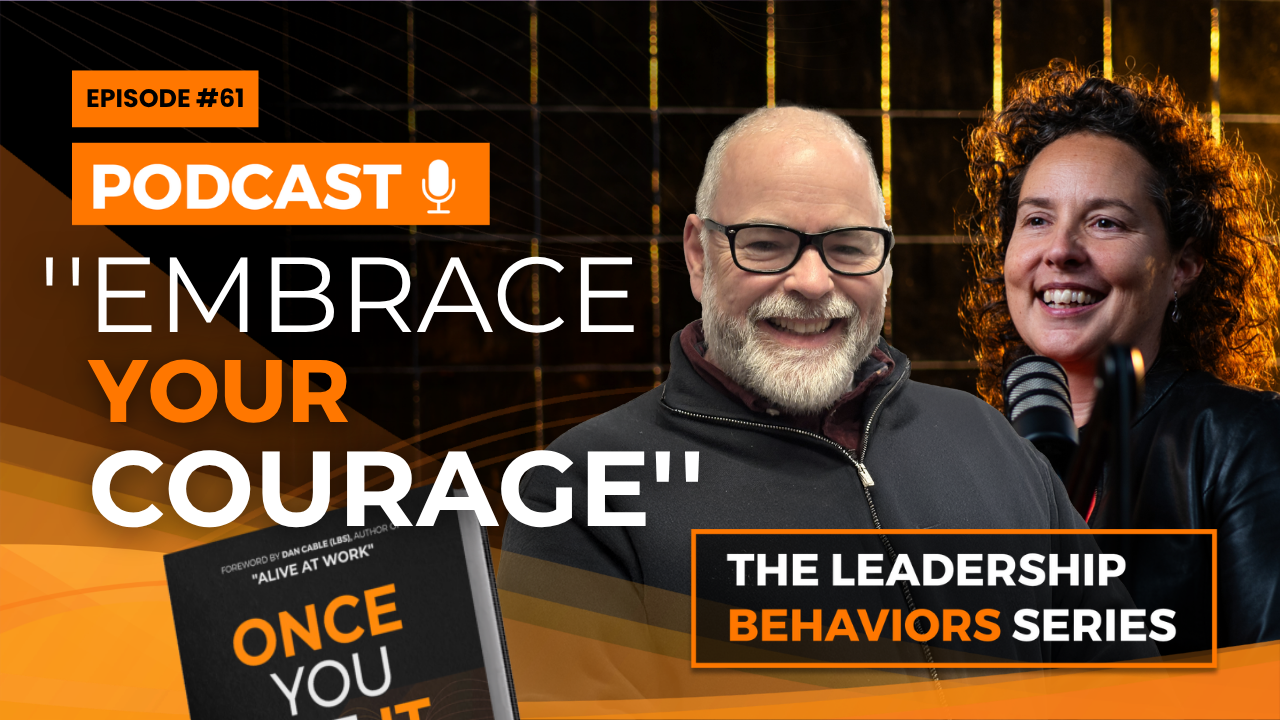
This is based on the podcast with Richard Stark. Check out the podcast or the video podcast!
This podcast is part of a series on behaviors for human-centric transformation, ‘Layer 3’ in Zanna’s new book: Once You See It.
If you want to dive deeper into creating organisational change that actually sticks, you can order the book here.